Paper Trading for Beginners Guide
This paper trading for beginners guide shows how to practice stocks and crypto with live prices, test strategies, and build confidence risk-free.
Advertisement

Edited & reviewed by Rishi Mohan
Founder & Editor · Founder & business owner · Updated June 2026
Most new traders do not have a strategy problem first. They have a hesitation problem. They want to buy a stock or trade crypto, but the second real money is involved, every price move feels personal. That is exactly why a paper trading for beginners guide matters - it gives you a way to practice in live market conditions without paying tuition to the market.
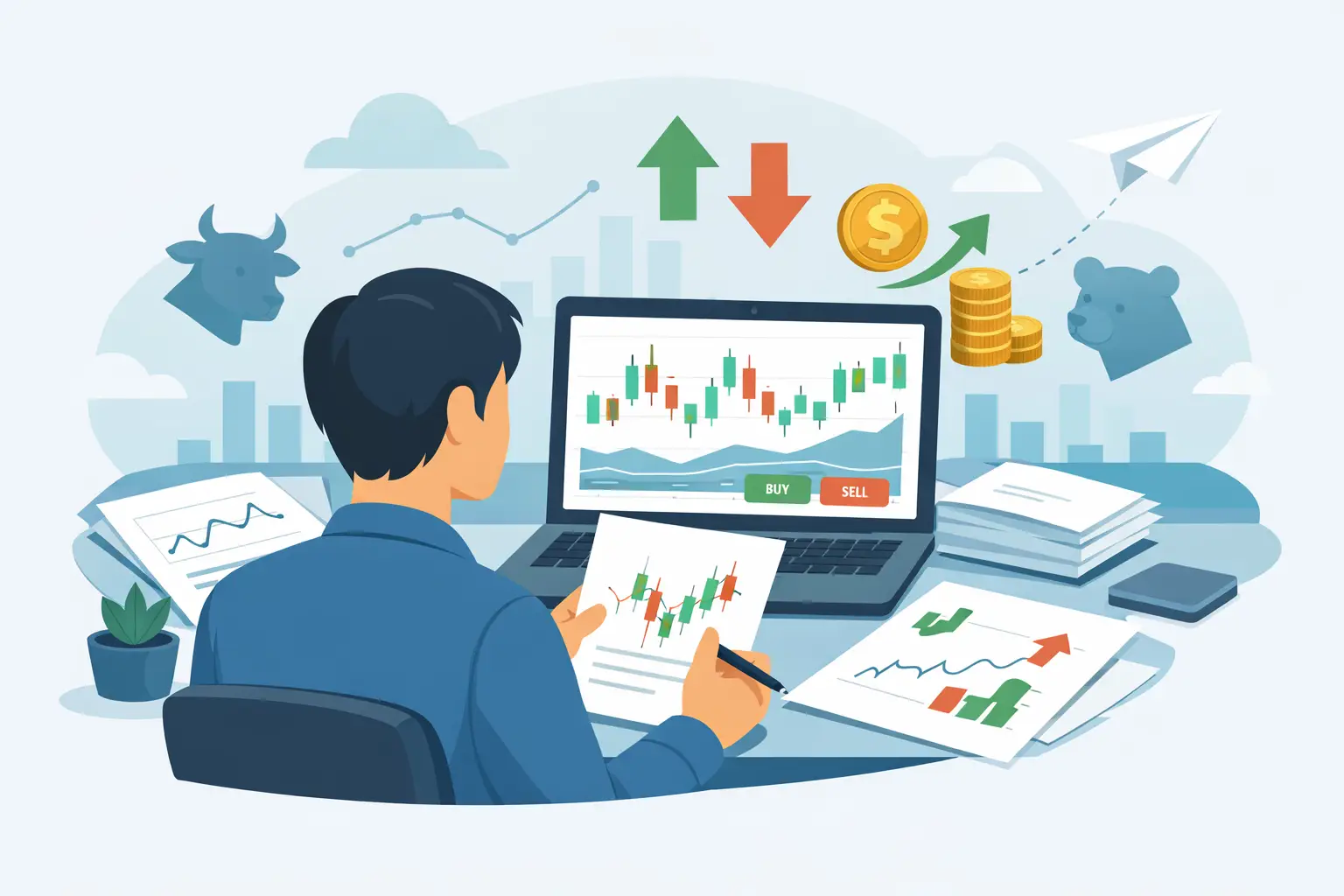
Paper trading is simulated trading. You place virtual buy and sell orders, track a portfolio, and react to real price movement, but no actual money leaves your account. For beginners, that changes everything. You get market experience, order-entry practice, and feedback on your decisions without the financial damage that often comes with learning on the fly.
What paper trading actually teaches you
A lot of beginners assume paper trading is just pretend investing. It is more useful than that when you treat it seriously. A good simulator helps you understand how markets move in real time, how fast sentiment shifts, and how hard it is to stick to a plan when prices are moving.
It also teaches the mechanics that many new traders underestimate. Entering orders, sizing positions, setting stop losses, tracking performance, and managing multiple positions all sound simple until you do them repeatedly under live conditions. Practice turns those actions from abstract ideas into habits.
There is a trade-off, though. Simulated trading removes real financial pain, and that means it also removes part of the emotional pressure. You can learn execution and strategy in a simulator, but discipline under real stakes still takes another step. Paper trading is not a replacement for live trading forever. It is the safest place to build your base.
Paper trading for beginners guide: how to start the right way
The fastest way to get value from paper trading is to treat it like a real account from day one. If you load up a fake portfolio with an unrealistic amount of capital and take random oversized bets, you might have fun, but you will not learn much that carries over.
Start with a virtual balance that matches what you could realistically trade later. If your eventual real account might be $1,000 or $5,000, simulate around that number. This keeps your position sizes and decision-making grounded in reality.
Next, choose one or two markets instead of trying to trade everything. Stocks and crypto behave differently across time frames, volatility, and news sensitivity. A beginner usually learns faster by focusing on a smaller set of symbols or one market category at a time.
Then define a simple process before you place your first trade. Know what would make you enter, where you would exit if you are wrong, and what target would make the trade worth taking. You do not need a complex system. You need repeatable logic.
A platform with live prices, real-time portfolio tracking, and AI-powered insights can speed up this stage because it shortens the gap between theory and action. Instead of reading about setups and hoping you understand them, you can test them immediately and see how they perform in current market conditions.
How to use a simulator without wasting the opportunity
The biggest paper trading mistake is random participation. Beginners open a simulator, place a few trades based on headlines or impulse, then decide the market is easy or impossible based on a small sample. Neither conclusion helps.
Use your simulator like a training environment. Pick one setup to test for a full week or month. That could be buying breakouts above resistance, trading pullbacks in strong trends, or reacting to earnings-related momentum in stocks. In crypto, it might be range trading during low-volatility periods or trend-following during strong directional moves.
Keep your rules narrow enough that you can review them honestly. If every trade has a different reason, you cannot tell what is working. If the logic is consistent, patterns start to show up. You may notice that your entries are fine but your exits are weak, or that your win rate is acceptable but your losses are too large.
This is where real-time portfolio tracking matters. It is not just about watching profit and loss. It shows how multiple positions interact, how concentrated you are in one idea, and whether your risk is balanced or accidental.
What beginners should measure while paper trading
You do not need an advanced analytics dashboard to improve, but you do need a few numbers that matter. Your win rate is useful, but it is only part of the story. A strategy can win often and still lose money if the losing trades are too large.
Pay attention to your average gain, average loss, and how often you follow your own rules. That last one gets ignored, but it is one of the clearest indicators of progress. If your strategy loses money but you executed it correctly, that is still useful data. If your strategy wins money because you broke your rules and got lucky, that is not a repeatable result.
Also watch how long you hold trades. Many beginners exit winning positions too early and hold losers too long. Paper trading exposes that behavior quickly because the pattern becomes visible across multiple trades.
Common paper trading traps
One trap is treating fake money like game tokens. If you take trades you would never take with a real account, your results will be misleading. Another is overtrading because there is no financial consequence. More trades do not always mean more learning. Often they just create more noise.
There is also the confidence trap. A hot streak in a simulator can make a beginner feel ready for full-size live trading. That move is usually too aggressive. Simulated success is encouraging, but it needs context. Ask whether your results came from a repeatable process, a favorable market phase, or a handful of lucky trades.
The opposite problem happens too. Some beginners stay in paper trading too long and avoid the next step because the simulator feels safe. That is understandable, but if your process is stable and your execution is consistent, at some point the next lesson is learning how you handle small real stakes.
Stocks vs. crypto in a beginner paper trading plan
If you are deciding between stock and crypto practice, the right choice depends on your personality and schedule. Stocks often offer more structure around market hours, earnings, and sector behavior. Crypto trades around the clock and can move much faster, which creates more opportunity but also more noise.
For beginners, stocks can feel easier to organize around because the market has a defined session and often reacts to clearer catalysts. Crypto can be useful if you want constant access and are comfortable with higher volatility. Neither is automatically better. The better starting point is the one you can follow consistently and review without getting overwhelmed.
A multi-asset simulator helps here because it lets you compare both environments without switching tools or risking capital. That matters if you are still figuring out whether you prefer slower decision cycles or faster momentum-driven markets.
When to move from paper to real trading
There is no perfect graduation date, but there are signs you are getting close. You can explain your strategy in plain English. You know your risk per trade. You have a record of results over more than just a few sessions. Most important, your process stays consistent whether the last trade won or lost.
When you make the switch, do not jump from simulation to full-size positions. Go small. Your first real-money stage is not about maximizing returns. It is about testing whether your behavior changes when gains and losses affect you personally.
If your execution falls apart with real money, that does not mean paper trading failed. It means it did its job by preparing your strategy, and now you are working on the psychology layer. That is normal.
Why this approach works for beginners
The best beginners do not try to look experienced. They build experience. Paper trading gives you a risk-free way to practice with live prices, test ideas, and learn how your decisions play out in real time. That makes the learning curve less expensive and a lot more honest.
If you use a modern simulator well, it becomes more than a sandbox. It becomes a feedback loop. You spot mistakes faster, refine your process sooner, and gain confidence based on evidence instead of hope. Platforms like Market Navigator make that easier by combining live market simulation, AI-powered insights, and real-time portfolio tracking in one place.
Start simple, stay consistent, and let the data teach you. Confidence built in practice tends to hold up much better when the market gets loud.
Put it into practice — risk-free
Practice with $100,000 in virtual cash and live market prices.
More from the blog
Paper Trading vs Live Trading Explained
Paper trading vs live trading comes down to risk, emotion, and execution. Learn when to practice, when to go live, and what changes.
How to Use Paper Trading the Right Way
Learn how to use paper trading with live prices, AI-powered insights, and real-time tracking to practice stock and crypto strategies risk-free.
8 Best Paper Trading Platforms
Compare the best paper trading platforms for stocks and crypto. See which tools offer live prices, realistic practice, and better learning.
Crypto Trading Simulator: Practice Without Risk
Use a crypto trading simulator to practice with live prices, test strategies, and build confidence without risking real money first.